Active recall
Korean Translation Practice Online
Translate English prompts into Korean and get corrections that explain every mistake instead of just marking it wrong.
Availability
Free
Practice, save attempts, and request feedback from a person.
Premium
Adds automatic AI corrections when automatic grading is enabled.
Watch a translation drill and how it's graded
What it does
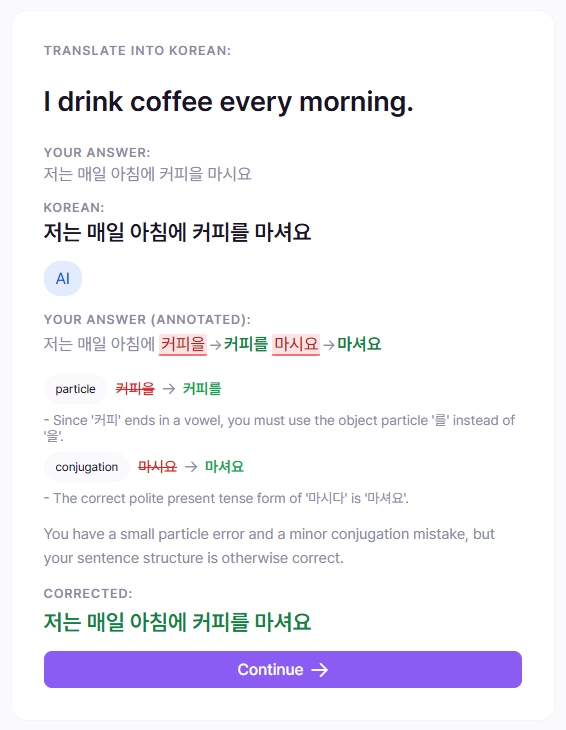
Elephant gives you an English sentence and asks you to write it in Korean. When you submit, your answer appears next to a reference translation, with each mistake annotated inline: a missing particle, a wrong verb conjugation, an odd word choice. Every correction comes with a plain-language explanation, and you see the fully corrected sentence at the end.
This is production practice, the part many apps skip. Recognizing a word on a flashcard and producing it in a grammatical sentence are different skills. Conversations depend on the second one.
How the automated grading works
An AI grader compares your answer against the reference translation, but it is built to accept valid alternatives: there is rarely exactly one correct way to translate a sentence, and a different but grammatical phrasing is not counted against you. Mistakes are classified by category, so the feedback distinguishes a vocabulary gap from a grammar slip from a simple spacing error.
Prompts are drawn from sentences built on vocabulary you have studied, so the difficulty follows your own progress instead of a fixed curriculum.
Automatic AI grading is a Premium feature, and both paid plans start with a 14-day free trial. On the Free plan, or whenever you would rather have a person check your work, share a translation with a friend or teacher and keep their corrections in Elephant.
Practicing over time
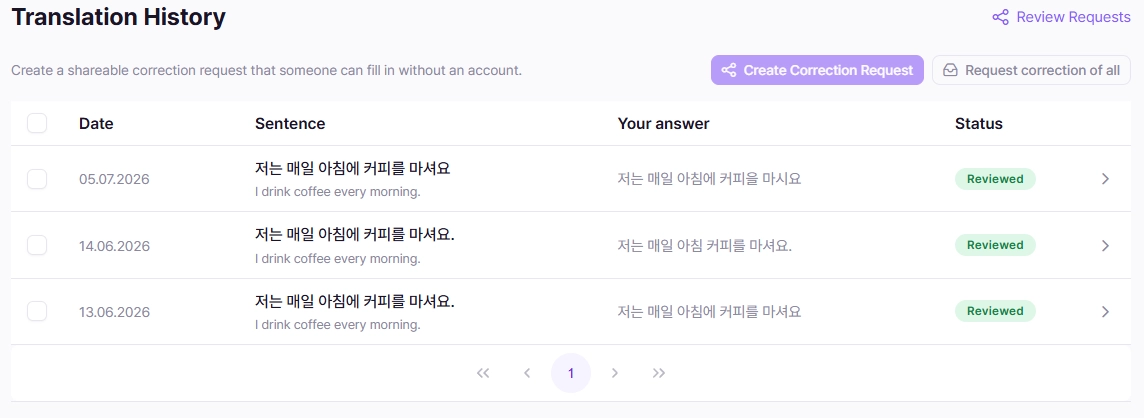
Every attempt is stored in a searchable history alongside its correction, so you can revisit the explanations for the mistakes you actually made. Your results also feed back into vocabulary review scheduling: words you fumble in translation come back sooner in your review queue.
See the corrections
Questions about Translation Practice
Are the AI corrections free? ▼
What level do I need to start? ▼
Is there only one correct answer? ▼
What happens to my mistakes? ▼
Can I translate from Korean to English instead? ▼
More ways to practice
Korean Sentence Analyzer
Write or paste any Korean sentence and get a word-by-word breakdown with grammar notes, vocabulary cards, a translation, and audio.
Korean Pronunciation Practice App
Listen to natural-sounding Korean audio, record yourself, receive word-level scoring, and try again.
Korean Example Sentence Search
Pick the grammar features and vocabulary you are studying and get matching corpus sentences, each linked to a full word-by-word breakdown.
Korean Word Scramble Practice
Put shuffled Korean word chunks into a grammatical sentence and learn how flexible Korean word order really is.
Korean Listening Practice
Train your ear with single sentences, dictation, whole passages, and multi-speaker conversations.
Write a Sentence in Korean
Turn vocabulary you have reviewed into Korean you can produce by writing an original sentence around one word.
Korean Number Practice
Build both Korean number systems through guided paths, then drill the everyday concepts that need more work.
Adaptive Korean Grammar Practice
Practice grammar points you have studied with targeted recognition and production tasks that adapt to your recent mistakes.
Korean Reading Practice
Read complete Korean passages, answer comprehension questions, rebuild their order, and place a missing sentence.
Start your first translation drill
Practice and shared corrections are free. Premium adds instant AI corrections; try it free for 14 days.
Sign up free