Reference
Korean Example Sentence Search
Pick the grammar features and vocabulary you are studying and get matching corpus sentences, each linked to a full word-by-word breakdown.
Availability
Free
Available with a free Elephant account.
Watch a search narrow down to real examples
The problem it solves
You look up a word, add it to your reviews, and still struggle to use it in a sentence. A particle or ending makes sense in a textbook, then disappears when you try to speak. Flashcards drill isolated material; Sentence Search puts it back in context.
Choose the words and grammar points you are studying. Elephant returns matching corpus sentences, each with a word-by-word breakdown and audio.
How you use it
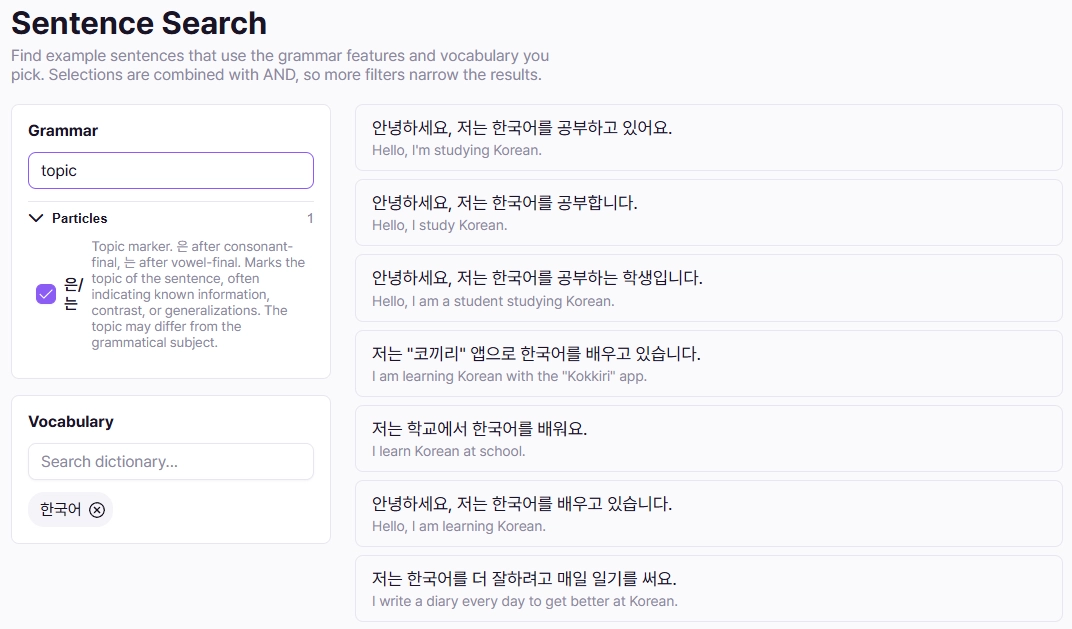
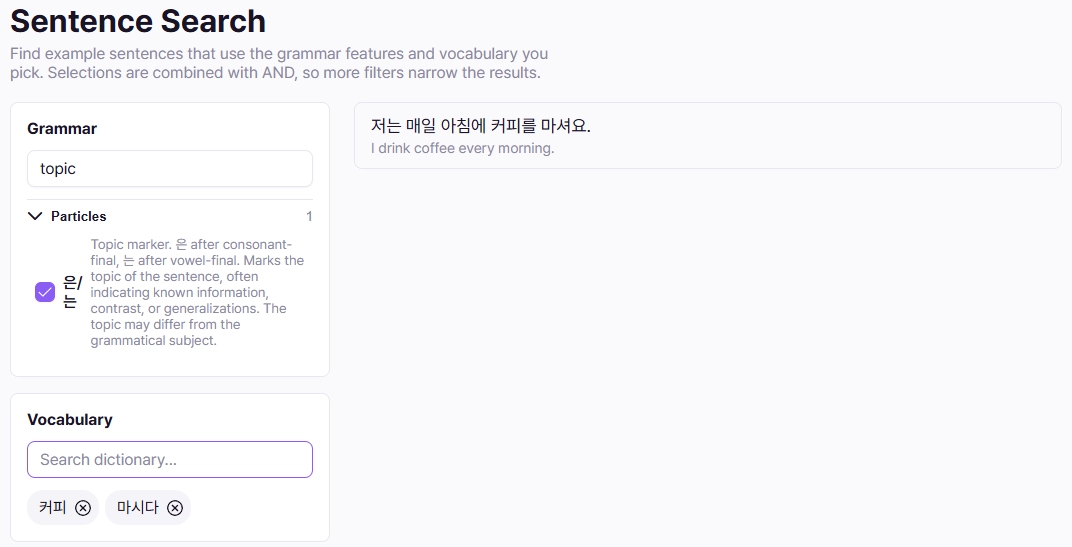
Pick an abstract sentence ending from the grammar list, search for words from your review queue, or combine both. Every filter must appear in a result, so adding a particle and two words returns only sentences that use all three.
Results come from Elephant's shared corpus. Search includes sentences that completed analysis and have not been excluded or content-flagged. If a spelling maps to several vocabulary entries, Elephant checks each one for matches.
Why it helps you actually learn
Repeated examples show how a grammar point behaves beyond one textbook sentence. That helps bridge the gap between recognizing an ending and producing it when you speak.
Vocabulary filters can also keep examples closer to familiar material. You spend more time seeing known words in context and less time decoding unrelated vocabulary.
What a search looks like
Questions about Sentence Search
Do I need an account to use sentence search? ▼
How many sentences does a search return? ▼
Can I combine grammar and vocabulary filters? ▼
Where do the example sentences come from? ▼
More ways to practice
Korean Sentence Analyzer
Write or paste any Korean sentence and get a word-by-word breakdown with grammar notes, vocabulary cards, a translation, and audio.
Korean Translation Practice Online
Translate English prompts into Korean and get corrections that explain every mistake instead of just marking it wrong.
Korean Pronunciation Practice App
Listen to natural-sounding Korean audio, record yourself, receive word-level scoring, and try again.
Korean Word Scramble Practice
Put shuffled Korean word chunks into a grammatical sentence and learn how flexible Korean word order really is.
Korean Listening Practice
Train your ear with single sentences, dictation, whole passages, and multi-speaker conversations.
Write a Sentence in Korean
Turn vocabulary you have reviewed into Korean you can produce by writing an original sentence around one word.
Korean Number Practice
Build both Korean number systems through guided paths, then drill the everyday concepts that need more work.
Adaptive Korean Grammar Practice
Practice grammar points you have studied with targeted recognition and production tasks that adapt to your recent mistakes.
Korean Reading Practice
Read complete Korean passages, answer comprehension questions, rebuild their order, and place a missing sentence.
Find sentences that fit what you are learning
Start free. Filter by grammar and vocabulary, then open any match for a full breakdown.
Sign up free