The Loop I Wanted and the Loop I Have
How I went from following outside courses to a sentence analysis study loop for Elephant.
When I started learning Korean, I used a variety of materials: A textbook from a college class, Talk to Me in Korean online classes, Duolingo, Memrise, Ewha’s self-study textbooks and more. They all provided good teaching material, but I still felt something was missing. None of them worked well together or built on each other. That was my original motivation for Elephant. There were community-made courses on Memrise for some of the books and courses I used, but Memrise is limited in what it can do on its own, and even the courses it had did not work well together. I would end up with flashcards for the same vocabulary in different courses, but I could not merge them.
So when I started Elephant, my main idea of how I would enter my study progress was detailed courses, inspired by the Memrise community courses. However, they should be based on the same underlying knowledge. If two courses contain
- Korean: 우리
- English: we
It should be the same entry. If I learned the “-요” form from HowToStudyKorean, it should keep that knowledge even when I switch to TTMIK.
So the full plan for a user would be: When onboarding, mark every course you know. Then, when studying a new chapter, simply tap the course in the Elephant app, and it will magically know the grammar and vocabulary the student has learned.
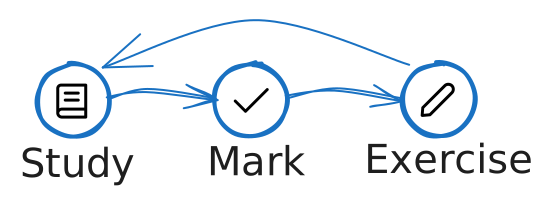
However, that plan did not get far. When implementing courses, I also put a non-technical item on my list: How do I feel about this, and what are the laws for copyright on this? Thanks to AI and the rather ruthless use of others’ work and data by AI companies, these are things many people have on their minds these days. I do not want to build something that feels like it is stealing from Korean teachers, much less something that is stealing in the legal sense. I like the creators of Korean content, the Korean guide, Minji’s Korean, TTMIK, HTSK, and all the others; I do not want to alienate those who helped the people who study there and me. So I won’t add “official” courses for any of those.
I need an alternative.
This is the studying loop I came up with: When you analyse a sentence, you can mark the grammar and vocabulary of the sentence as known.
These choices build the user’s knowledge graph and determine which sentences are available to study. In most cases, if a user knows all of the vocabulary and grammar in a sentence, they should be able to understand, translate, or pronounce it. The modified study loop graphic now turns into this:
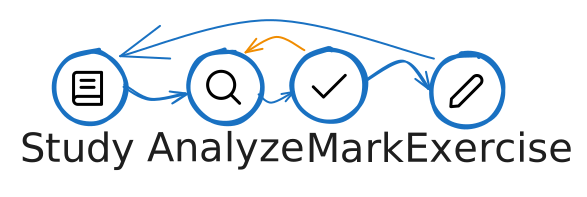
The new study loop is not a pure downgrade. It ties your exercises to what you actually studied, and it helps build the repertoire for sentences you and everyone else have available. However, it is clearly slower than marking just your studied classes. A downside, especially for advanced students.
To mitigate these issues, I still want to add proper courses someday, after reaching out to the creators and creating a way to import the material to Elephant. In the meantime, users can create courses to share with others, and their creation should be simplified as well. One idea I consider is creating the course information from a set of sentences. Elephant will analyse all of them, and the course will contain all the vocabulary and grammar used.
The course-based loop is still the one I want. For now, that is not the one I can have.
David
Comments